MEDITATION

MUDRA
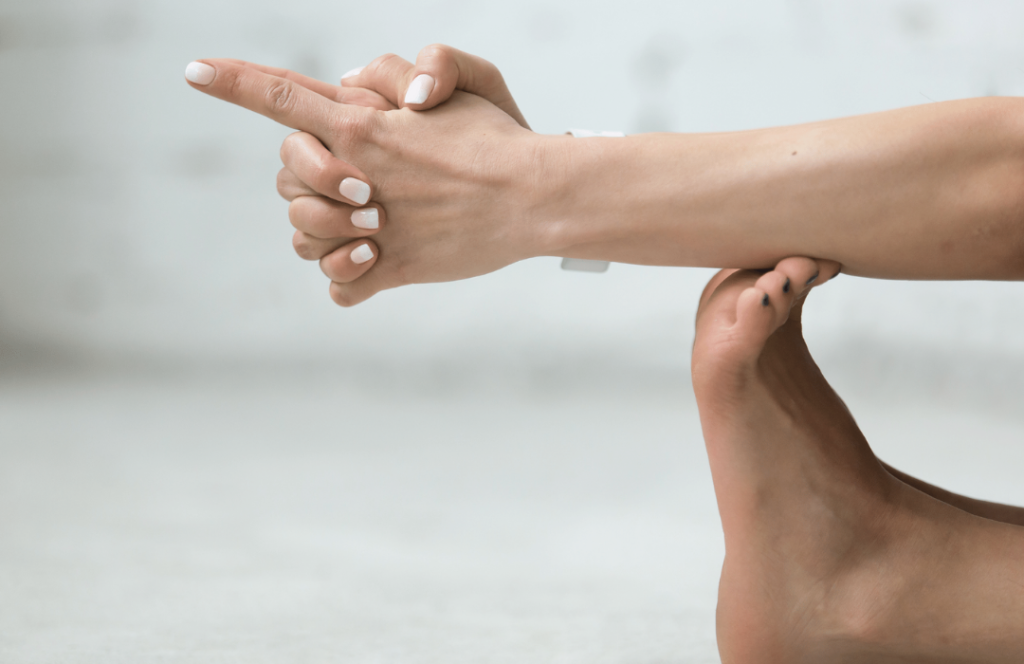
Mudra can involve the whole body in Asana, pranayama, and Dristi (visualization techniques) or it can be as simple a a Hand gesture. Mudras were not intended to be learned from a book. Practical instruction from a guru is considered a necessary prerequisite before beginning to work with them, Mudra are higher practices which lead to the awakening of the kundalini energy and should be used with caution.
Mudras manipulate prana much in the same way that energy in the form of light or sound is manipulated by a mirror or a rock face. Normally the energy that is circulated by the nadis in our body escapes and dissipates in our environment. That is why highly sensitive people might find it difficult to be in a certain place or around a certain person. Like attracts like. To be clear, the catch phrase “opposites attract” is absolutely false!
Yoga literature states that once the dissipation of prana is arrested thought the practice of mudra, the mind becomes introverted, and ready for the steps toward Samadi- Pratyahara (control over the senses) and Dharana (concentration).
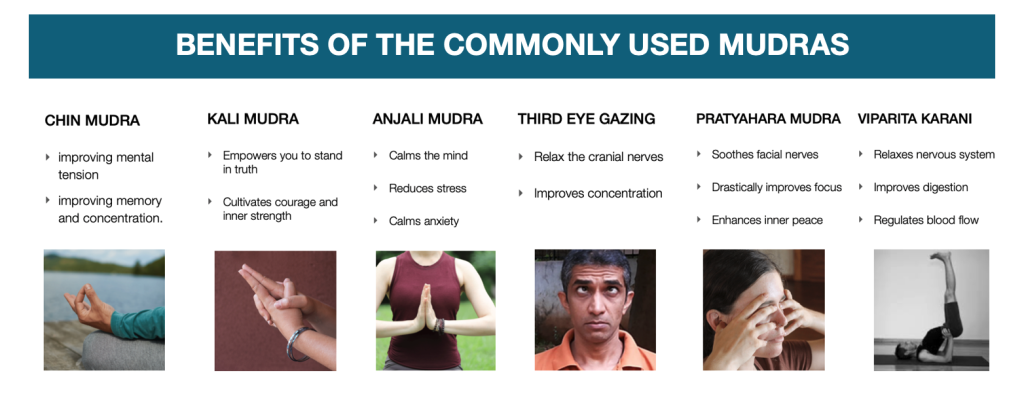
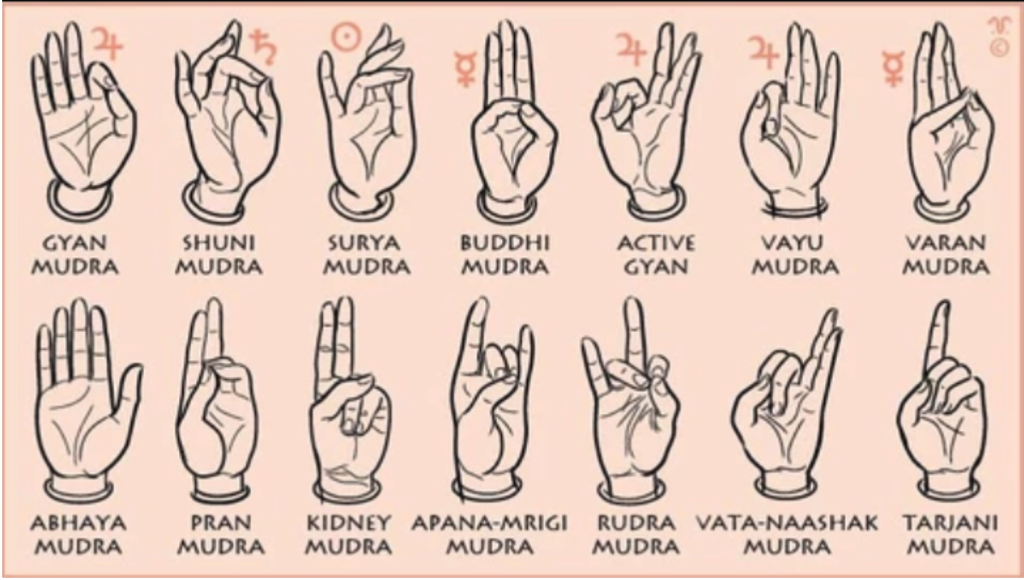
There are 5 types of Mudra. If you are a practicing yogi, you will recognize many of them as they are often incorporated into the asana practice. Here we give you examples of each.

HEAD
HAND
PERENIAL
LOCK
WHOLE BODY
DRISHTI
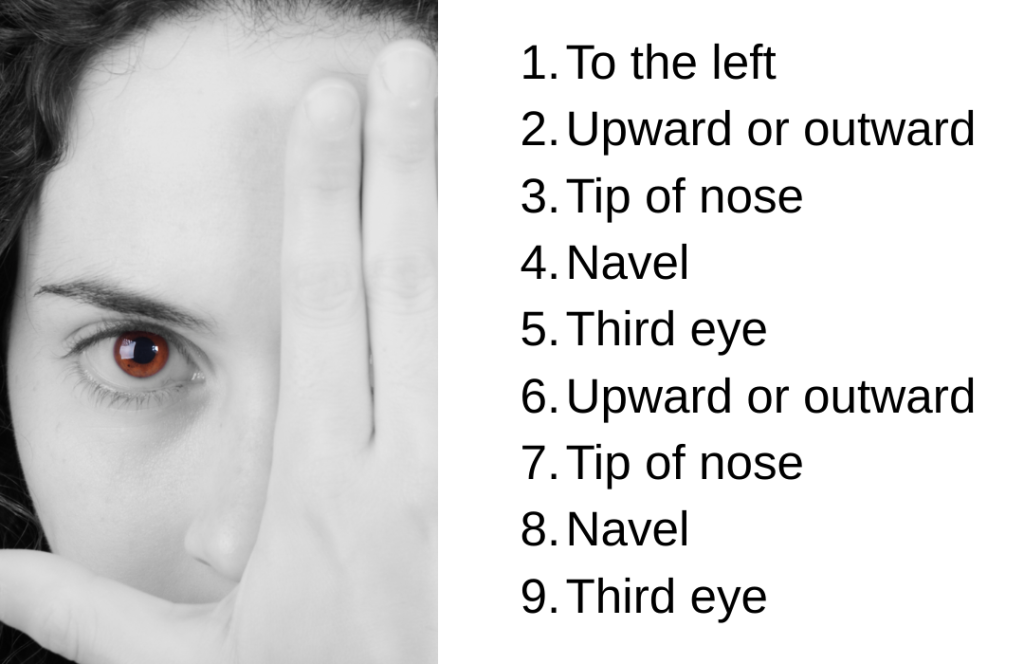
Drishti is a Sanskrit word that means vision or gaze. In Pantanjali’s yoga sutras dristi is closely related to the upper limbs. This is because we are working on improving our concentration in preparation for meditation.
In yoga Asana practice, we can use Drishti in two ways. The first is by physically placing the gaze onto a specific point in our external environment, such as onto our hands or feet. This helps us find balance and focus in all asanas. The second way we can use Drishti is to help guide our awareness inward, which helps us steady and settle our mind. By guiding our eyes to rest on a specific point, we build concentration and eliminate distractions from our surroundings.
Your gaze is a very powerful tool. Wherever your gaze wanders, (whether it is inward or outward) your attention and prana (life energy) follow.
Knowledge of the various Drishti is a valuable addition to your yoga and meditation practice. Play with each one, try them out in your next yoga class and see if they help you find balance more easily and move deeper into your practice.
Traditionally, there are 9 Dristi points. They can be used as external points of focus or used to tune out distractions and bring attention inward. Which one you chose to use in any given pose really doesn’t matter too much. Just pick one and stick to it. They are:
PRATYHARA
Pratyahara is often compared to a turtle withdrawing its limbs into its shell– the turtle’s shell is the mind and the senses are the limbs. Pratyahara, the fifth of the eight limbs of yoga, provides the foundation for the higher practices of yoga and is the basis for meditation. By linking the breathe with the withdrawal of senses, it is possible to completely take our mind and breathe out of the realm of the body.
In yoga there are no express trains.
The wisdom that the lower limbs teach (Yama, Niyama, Asana, Pranayama) is only preparing your body and mind for future steps. Steps that can take years—let’s say decades. For example: we may study Pranayama and Asana in addition to the Pratyahara technique outlined below for about 10 years, and then, finally, it will be time to lift our asana into a non-physical realm—but not always, just sometimes. If we’re lucky and have good teachers.
If you have a good foundation in the lower limbs then the Pratyahara technique practiced in Savasana (instructions on next page) will be ready to kick in during downward dog or Triangle pose.
Once you are able to do that, then you will be properly prepared to delve into the higher limbs, Dharana & Dhyana (concentration and meditation) and have a greater chance of entering Samadhi in this lifetime. But rest assured, if not this lifetime, likely the next, as our gurus remind us that consciousness doesn’t die, we get to take all our hard work with us 🙂
DHARANA
Concentration
Now we’re into the higher limbs of Patanjali’s Yoga. The upper limbs— Dharana, Dhyana and Samadhi—leave a lot of questions, even in the minds of well educated yogis. The first 5 limbs are relatively straight forward—“this is what I need to do… this is how.. and these are the benefits…”. They are tangible. We clearly see the results of our practice, which are great physical health and a wonderful sense of wellbeing. But that is not all yoga has to offer.
The real fruits of our yoga practice have yet to be experienced. We have only now prepared ourselves for the true joy that is to come in practicing the 3 higher limbs; these are related to cultivating a relationship with your true nature, your higher-self and the Divine.
By the time you’re ready to start playing in this arena however, ideally, and most Gurus would insist, you need to be in optimal physical and emotional health. Most of you will agree because you have experienced this truth first hand at some point or another…it’s really difficult to concentrate when you’re in physical or emotional pain. But it is in practicing these higher limbs that the real magic starts to happen. So bottom line is, it’s worth the effort to get here.
In short, Dharana is intense concentration on a single object. This could be a flame, a sound, a mantra, an image, pulse, breath etc. It is focus on something external. Something in the physical realm that can be seen, heard, smelt, tasted or felt.
Yoga offers us many techniques and tools. Japa Meditation, using a mantra or a seed sound is a well known one that is interestingly, used in many spiritual practices and religions, not just by yogis. You can use any of the following. It is recommended that you try a few out and see what the best fit is.
Here are some ways to practice concentration:
- Everyday object: flower, statue- anything that is meaningful in some way
- Body part: concentrating the mind on one part at the exclusion of the others
- Breath: entering and leaving the body
- Yantra: symbols, there are many, do a google search
- Mantra: a sound, or a short phrase. Om is a a good one for yogis because its very soothing to use a sound rather than a word that has meaning and the potential to induce thought, but it could also be something as simple as “I am love”
DHYANA
Meditation & the steps to achieving Samadhi
Resources:
- The Yoga Sutras, Patanjali
- Samkhya Sutras
- The Mind Illuminated, John Yates, PhD, Matthew Immergut, PhD, and Jeremy Graves
DEFINITIONS OF TERMS USED IN THIS CHART
Attention: the cognitive ability to select and analyze specific information while ignoring the other information arising from the vast field of internal and external stimuli.
Peripheral Awareness or awareness: paying attention to some things while simultaneously being aware of but not attending to others.
Dullness: lack of mental energy. Degrees range from deep sleep and drowsiness, to feeling spaced out or experiencing a void in which nothing is perceived at all.
Forgetting: is distraction which causes the meditation object to disappear entirely from conscious awareness.
Distraction: anything at all— sound, thought, feeling, that competes with the meditation object.
Gross distraction: when some mental or sensory object becomes the primary focus and pushes the meditation object into the background but not out of awareness.
Hindrances (kleishas- Patanjali’s obstacles): desire, aversion, lethargy, agitation (worry, regret) doubt.
Illumination phenomenon: an inner light that often occurs with the pacification of the visual sense.
Insight (vipassana): refers to profound intuitive realizations, different form intellectual knowledge.
Jhana: profound states of meditative absorption in which both the focus of attention an mindfulness have become refined. A special flow state is achieved only in meditation, a means for accelerating your progress. See bottom for whole body Jhana.
Labeling: Technique used to strengthen introspective awareness. It entails identifying a distraction with a simple label the moment you realize you are no longer focusing on the breath.
MIA (metacognitive introspective awareness): awareness in which the mind “stands back” and observes its own state and activities – and awareness of the mind itself
Sadhaka: the student.
SIA (Spontaneous introspective awareness): AHA moment when you realize you are not doing what you intended.
Contraindications and precautions
- A history of psychological challenges
- Some psychotropic medications
Signs of potential breakdown
- Person has trouble staying in their body
- Loss of sensation in arms, hand, or legs while meditating (more than going to “sleep”)
- Spaciness, a sense of expansion without grounded-ness
Suggestions for dealing with breakdown
- Keep eyes open
- Reduce meditation time
- Increase physical activity (yoga)