Anatomy | Lesson Two -Alignment and Energetic Principles
A Foundation In Alignment
ALIGNMENT IN YOGA
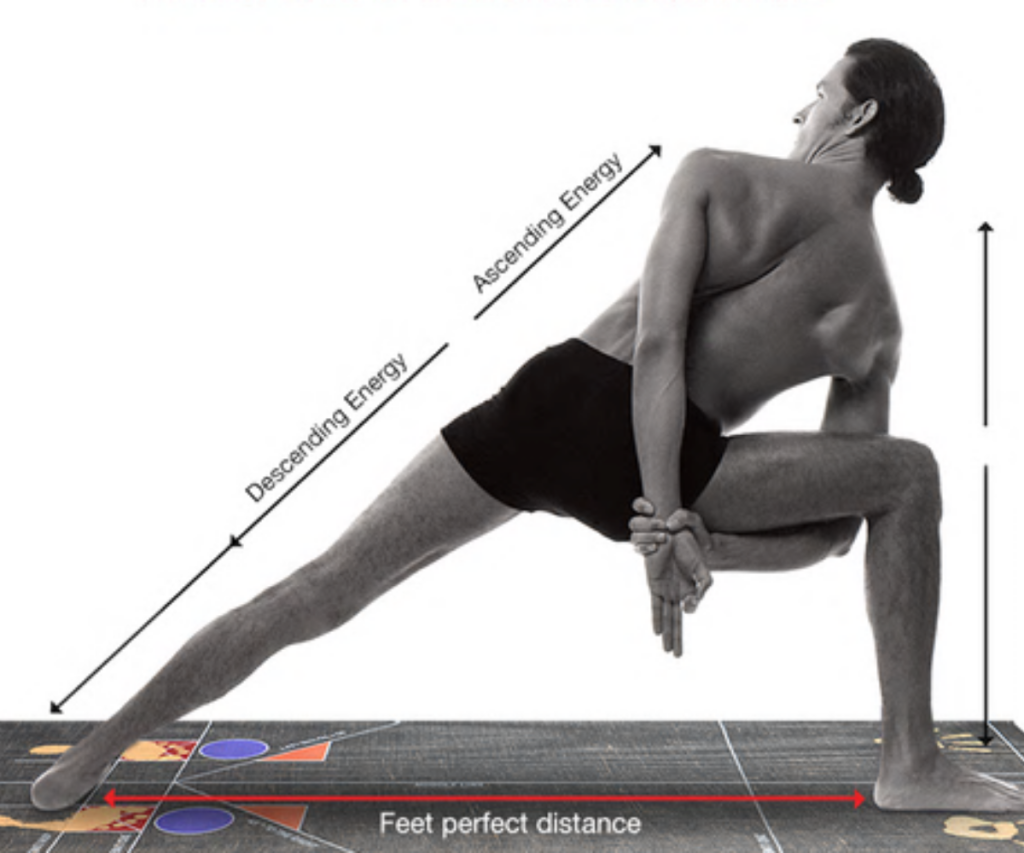
“Proper Alignment” refers to optimal use of body mechanics and is important because it prevents wear and tear on the muscles and connective tissue, especially around the joints, which tend to be susceptible to injuries when body posture is not ideal. Alignment in Yoga refers to correct form in asana. Proper alignment will simultaneously maximize the benefits of the poses on the physical level, by increasing flexibility and strength, and on the energetic level, by stimulating the correct flow of prana throughout the body, all the while preventing injuries. The key to finding “proper alignment’ is in the muscle engagements of the body. It is important to note that every human being is built differently and therefore the asana may look drastically different from one person to the other while still considered in proper ‘alignment”.
THE LANDMARKS
The following points I refer to as “landmarks”. It is important to note that these alignment principles are not lost or forgotten when the body starts to move. Whether the pose is mountain or seated forward fold with the legs straight out in front, correct alignment still applies. Even in final relaxation posture, the body should feel ‘aligned’.
It is important to note that there are two kinds of energy: muscular and organic.
Organic energy is an abstract concept and, therefore, should be brought into the practice with some help from the imagination.
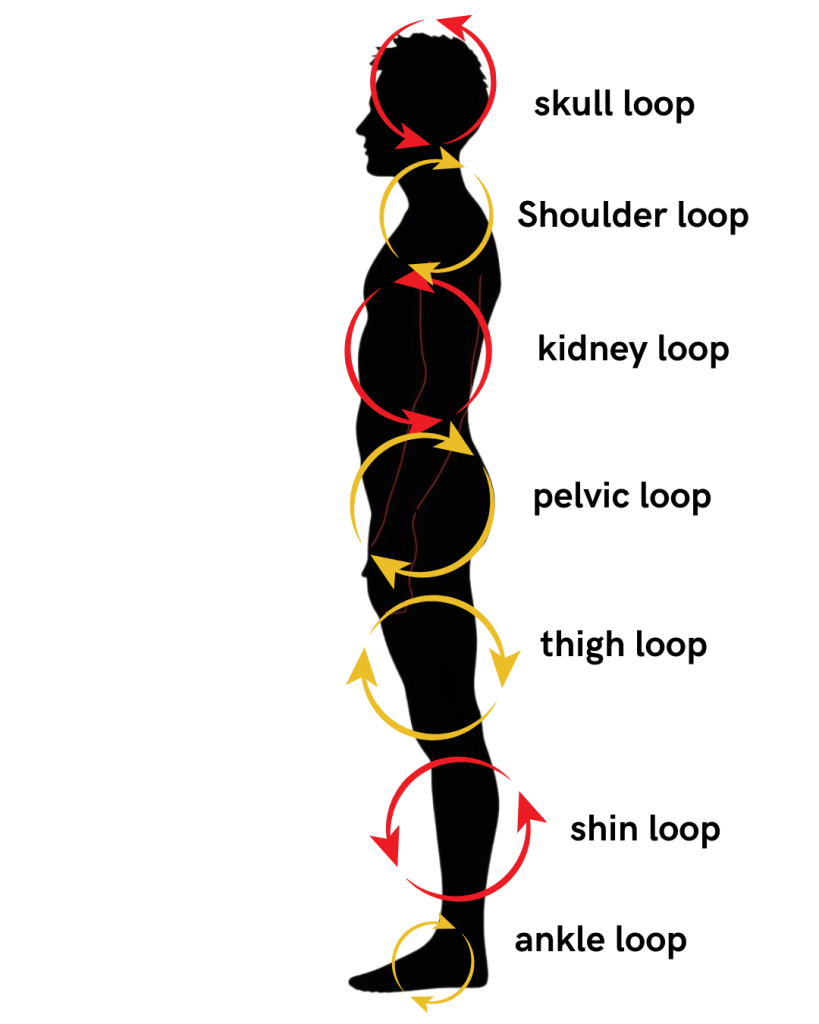
The Shoulder Loop
The Kidney Loop
The Skull Loop
The Pelvis Loop
The Shin Loop
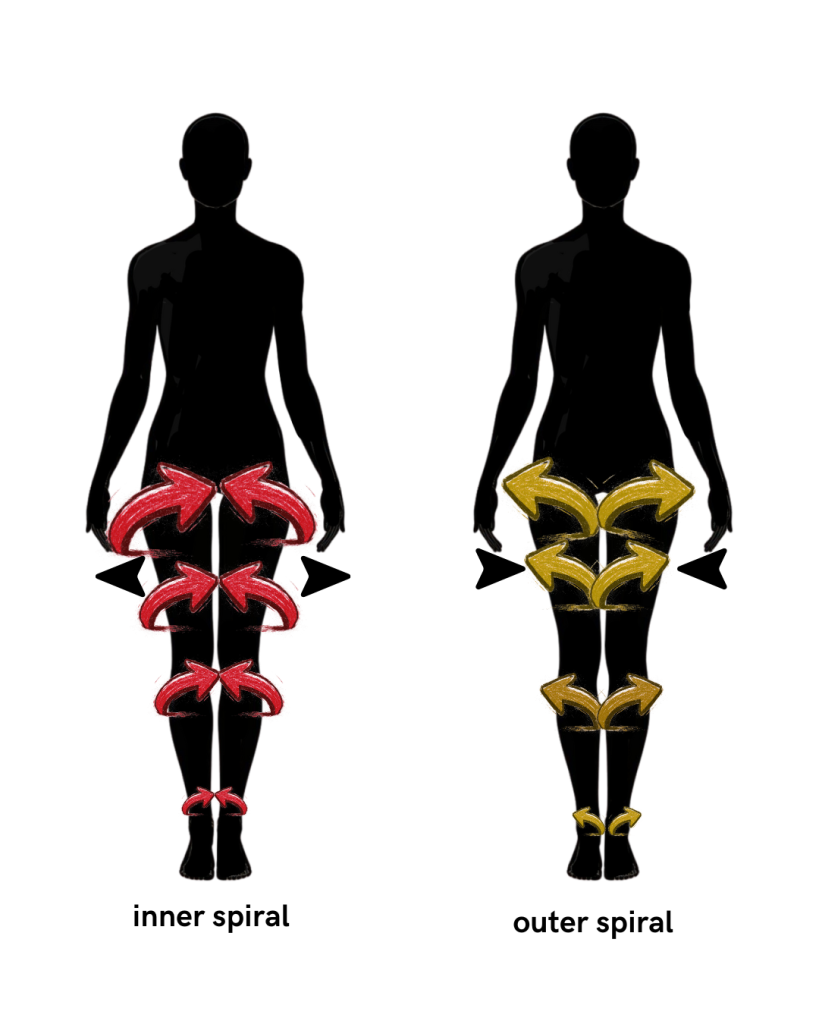
Inner & Outer Spirals
The Foundation: The Feet
The feet are the most important focal point for the beginning student. I always tell them that this is the starting point, their primary focus for the first 6 months of asana practice.
Without a strong foundation, the structure crumbles. If your feet are weak or have imbalances, i.e, you are pronating or supinating, which naturally affects the knee joints and will eventually move its way up to the hips and then the spine, and so on, wreaking havoc on the entire body. Simply correcting imbalances in the feet may be enough to correct overall structural alignment in some people.
The feet are made up of 26 bones and deeply connected muscles; they are designed to carry our weight, balance us, and propel us into motion. Thanks to the use of shoes, the feet are, more often than not, denied the benefit of walking unimpeded. As a result, over time, humans have managed to marginalize their feet.
The human body naturally adapts to its environment, so it just makes sense that when we stop calling upon every muscle and bone in the foot to do its job, they simply stop doing their job.
As yoga teachers, it is important to re-educate our students on how to intelligently use their feet and develop those muscles that perhaps have not been used in a very long time.
Muscular actions required:
Spread the toes, making floor contact with all four parts of the foot: the ball of the foot, big toe and pinky toe side, and inner and outer heel. The feet firmly press into the floor, so that the insteps are visibly lifted and active. Be mindful not to grip the floor with the toes; keep the toes soft and relaxed (not gripping the floor) unless the heel is off the floor.
The Grandfathers of Yoga called this PADA BANDHA.
The Legs
Actively engage the muscles of the legs, lifting the knees. If there is a tendency to hyperextend & lock the knee joint (by sinking into the joint and relying on “bone stacking” for balance) then the knees will be slightly bent. “Actively” engaging muscles means contracting and making the muscles firm in the area.
The Pelvis
Engage the abdomen, or core, of the body as if putting on a seat belt, keeping the area from the hips to the shoulders (core) strong and stable but not rigid. The tailbone will naturally tuck down and under to point to the floor, which helps stabilize the back muscles.
“Bring length to lower back”, “Lengthen tailbone down”, “lift the fronts of the hip bones”, “Move waistline back”, “Draw the belly up and in”.
The Heart (Sternum) & Shoulders
“Lengthen the side-body, move the humerus bones up and back, and draw shoulder blades into towards the spine”, “Bring bottom of shoulder blades toward heart & back of heart forward”, “Lift your heart.”
Organic energy: Try to imagine a line of energy that starts at the centre of the upper palate, and loops around down the back of the neck and upper back to the bottom of the shoulder blades, forward through the bottom of the heart and top of the diaphragm, then up the chest and throat from the base of the sternum and back to your upper palate.
The muscular action of depressing the shoulders, while keeping the scapula flat on your back and lifting the sternum, is required.
An exaggerated “shrugging of the shoulders” is the easiest way to accomplish this.
The Neck & Head
“Draw your ears over your shoulders”, “Drop your chin and reach up through the crown of the head”, “Draw your hyoid in.”
Organic energy: Imagine a circle of energy that begins centre of the upper palate; moves back & up along the back of the skull, forward over the top of the head, then down the face back to the upper palate.
Teaching Asana